Tuesday, April 29, 2014

A few Thoughts On Portable Radio Collectability


The current interest in collecting portable radios seems to stem from the recent profusion of portable electronic devices.  This profusion includes smart phones, MP3 players, tablets, etc.  For some time radio collectors have realized that the origin of portable entertainment, communication, and computation devices originated with the portable radio.  Other than this historical fact, there may be other reasons for the current interest in collecting portable radios.

There are lots of old portable radios out there.  Many were stored in bottom drawers, attics, basements, and some forgotten corners.  They often turn up at flea markets, garage sales, and especially on eBay.    On a recent day eBay had listings for more than 20,000 portable radios.  Most of those radios were transistor sets dating from the 1960s onward.   Of those on eBay over 2,000 radios were listed as “collectables”.  Needless to say, most of the so called “collectables” were of little interest to collectors or even to anyone in need of a cheap portable radio.  It’s not surprising that the people listing those radios on eBay know little about collecting portable radios.  The number of serious collectors is a very small fraction of people owning portable radios.  So, to most people any old radio thought to be useless may be considered as “collectable”.

Despite this common misperception, any portable radio is not necessarily a collectable portable radio.  Even if there is no information about an old portable radio on the Internet or to be found in reference books, the radio may not be rare or collectable.   There were so many portable radios produced that many of the less interesting ones are simply ignored by collectors and the media.  If the radio is both unreferenced and nondescript it is probably not collectable. 

Now, the seriously collected portable radios fall into several general categories.  There are the early tube sets, the prewar tube portables, the post war tube portables, and the early transistor radios.  A few radios such as novelty portables or the WWII military RBZ portable, fall outside those categories.  But, most collectors are interested in radios falling in the four categories listed.  Of course, condition of any radio greatly affects the value to a collector.  Radios in poor condition are collected mostly for parts.  The ideal radio is “as new in the box” and is valued the highest.


The RBZ portable radio is popular with the military collectors, but is seldom of interest to main stream portable radio collectors.


 The early tube portables are very collectable and very rare.  Portable radios built between 1921 and 1929 were very large and are seldom complete as found.  They are difficult to restore because their components are almost non existent.  Consequently, many early sets in poor to fair condition are cannibalized to restore better sets.  This, of course, increases their rarity.  Also, many of these early portables were damaged by rough transport and from battery leakage.  The prices are very high for some of these portable due to rarity and design.  But the number of collectors interested in these early portables is limited and decreasing yearly as collectors that relate to those sets pass on.  For the mainstream radio collector, they may not be very collectable in the future.  Rare: yes, collectable: to be determined.

The ultimate collector for these early portable sets will probably be museums.  Only museums have the resources needed to properly preserve and document the older portables for posterity.  But, the number of museums interested in the radios may be limited by the number of people interested in the history, which will no doubt be few.

            From the late 1920s until about 1938, the number of portable radios sold was on a steady decline.  The portable sets of the late 1920s were portable more in name than reality.  Their batteries were expensive and battery life short.  Most of the portables offered during the early 1930s were really battery powered radios for the farm.  Few farms at the time had electric service.  Few true portable radios (designed to be operating while being carried) were available during this period.  Those that were available were expensive and performed poorly.  Consequently, they were not very popular then and therefore are not considered very collectable now.  Popularity often indicates collectability.

The pre WWII portables are an interesting mix of battery only sets and sets that operate from batteries or house current.  The turmoil in Europe during the late 1930s renewed the public’s interest in portable radios.  In 1938 the public wanted a radio they could take anywhere to could keep abreast of European war news.  That demand was met by several manufacturers.  But, the “suitcase” portable radios offered in 1938 and 1939 were still too large and too heavy.  The smallest 1939 radio was a rare three tube personal radio made by Majestic.  That radio was not a great performer, but it whetted the public’s appetite for better small personal sets.  Still, due to its novelty and history, many portable radio collectors would consider this radio very collectable.


The Majestic personal portable of 1939 is unique, historic, and rare.  Consequently, it should be considered collectable.


 In 1940 RCA and several other manufacturers offered radios based on newly developed miniature tubes.   Some of those radios were small enough to fit in overcoat pockets.  Many sold well; some sold extremely well, like the RCA Personal Radio (BP-10).  But, for the public small size was not an over riding factor for the pre war portables.  Due to the small size, personal portables had short battery life.  There was simply no room for large long life batteries.  So, before the war the public usually compromised and bought portables that could run from batteries or house current.  These portables were generally larger than the small personal portables, but the larger size was offset by the power supply flexibility.  They outsold the personal portables by about five to one.  Surprisingly, their prewar popularity does not make them very collectable.  Many of the portables that could run from batteries or house current were rather plain and very similar.  For the most part, collectors have ignored them.

Most radio collectors know that, with the exception of military radios, no U.S. radios were produced during WWII (1942 to 1945).  This hiatus resulted in a big difference in both the quantity and appearance of tube based portable radios available after the war.  From 1945 on, postwar tube portables were produced in tremendous quantities (along with just about everything else).  And, portable radios took on a more artistic appearance.  Plastic was used extensively to add both color and form to radios that were once rather utilitarian.  The public loved them at the time, but collectors shun them today.

The majority of the postwar tube portables were designed to operate on battery and house current.  The portables designed to operate only from battery were not very popular.  A small number of manufacturers tried to interest the public in small battery portables, but most attempts failed.  Only the smallest of the post war tube portables seem to be of interest to collectors.  An example would be the Motorola Pixie of 1955.  It was one of the last tube based personal portable radios and is fairly rare.


The 1955 Motorola Pixie was small, but not as small as transistor radios of the same era.


            Strangely, there is also some U.S. collector interest in Japanese tube portables produced after WWII.  Most of the Japanese portables were the same electrically (four tubes), but their enclosures were inexpensive plastic of exotic appearance.  Apparently, the fragility, rarity and wide variation in maker labels make them of interest.

            The next big thing in portable radios was the portable transistor radio.  Transistor radios form another large and interesting collectable category.   Starting in late 1954 with the Regency TR-1, the number of transistor radio models mushroomed to and almost uncountable number.  Transistor portable radios were produced initially in the U.S., then Japan, then the rest of the world.   

            There seem to be several collector interests for transistor radios.  Early historic first generation transistor radios are collectable, because they were the first transistor portable radios and most were made in the U.S.  Some are fairly rare, but most were made in huge numbers.  Transistor radio collectors seem to gravitate to the radio of rare color or unique design. 

            By the 1970s, with the exception of the Zenith Transoceanic, no transistor portable radios were produced in the U.S.  So, collectors with interest in less expensive (i.e., newer) transistor radio looked to radios from Japan, Hong Kong, etc.  The color, style, and rarity, of the Japanese transistor radios are big draws to a large number of the transistor radio collectors.  Some early Japanese radios were not imported and are rarely seen in the U.S.  Later radios were quite sophisticated in style and performance.   It looks as if the future of portable radio collecting will be in transistor radios.  The wide range of portables from novelty radios to very exotic looking radios provides something for every collector.


 This is a small “boom box” typical of the 1980s.  It’s very common, very gaudy, very inexpensive, and not very collectable.


 All that being said, collectors themselves decide what is or is not collectable.  Just because a portable radio is rare, unique, historic, or esthetically pleasing does not make it collectable to every collector.  As with most collectors, true portable radio collectors collect what they like.

Tuesday, March 4, 2014

Music in a Suitcase: The Portable Radio Renaissance


Before 1938 the number of portable radios available was rather small.  The Great Depression was in full swing and most people had little money for an extra radio.  Despite the economic situation there were a few small radio manufacturers and some hobbyist building portable radios.  Most of those early portable radios, offered commercially during the early 1930s, were housed in nondescript wooden enclosures.  That changed in 1938.

In 1938 Philco Radio Corporation came out with what their advertisements called “An entirely new kind of radio, invented by Philco engineers”.  Well, it wasn’t all new, but it looked rather snazzy housed in a wood enclosure covered in “airplane cloth” which was similar to the covering used on luggage of the period.  Airplane cloth was so called because it resembled the fabric covering used on early airplanes.


Typical suitcase of the 1930s and 40s.


The earliest known portable radio covered in “airplane cloth” was a home built portable radio featured in the September 1936 issue of Popular Science magazine.  It was called a “Picnic Portable”.  The author of the article, Arthur C. Miller, had his home built radio housed in an enclosure built and covered in luggage cloth (airplane cloth) by a “neighborhood trunk shop”.  It’s not known if this is the first radio made to look like luggage, but it was not the last. 


The 1936 home built Picnic Portable radio.


The portable radio advertised by Philco in 1938 as “An entirely new kind of radio…” was known as the “Little Pal”.  It started a portable radio renaissance.  The overall look of the “Little Pal” was copied by almost every major radio manufacturer at the time.  From 1938 through 1940 many portable radios were offered in luggage size packages.  The earliest were designed to operate only from batteries.  But, that changed some time around 1940 when it was possible to add house current operation to the portable radio package.


Two “suitcase” portable radios of the late 1930s, the RCA Pick-me-Up radio on the right and the Philco Little Pal radio on the left

After that most portable radios were capable of battery and house current operation.  The exceptions were the so called personal radios.  Those were built rather small to facilitate easy portability.  As a consequence they were too small to include the parts necessary for house current operation.   Suitcase size portable radios operating only from batteries generally went away after 1941.  There were a few post war attempts to market large portable radios operating from batteries only.  Most of those were not popular with the public.   But, the idea of a suitcase size portable did not die.  The idea of a large portable radio was famously revised in the 1970s as the “boom box”.  Most “boom boxes” were not exactly suitcase size nor did they appear to be luggage.  So, sadly the music was no longer in a suitcase, just in a large plastic box.


Monday, November 11, 2013

Where did all this stuff come from?


Today we have smart phones, tablets, MP3 players, and lots of other portable electronic devices too numerous to name.  A few years ago we also had pagers, personal data assistants, portable CD players and others.  It would seem that all these portable marvels must have originated with the ubiquitous transistor radio of the 1950s.  But, that’s not exactly correct.  It really started much earlier.  As far back as the early 1920s some speculators suggested that a portable radio might be possible.  It  was possible and happened quickly.  In 1924 Zenith introduced the first fully contained (radio, batteries, antenna, and speaker) portable radio.  It was suitcase sized, but it was portable.  In 1925 the Radio Corporation of America (RCA) offered their portable model 24 Radiola and Westinghouse and others followed with similar self contained portable radios.  Thes portable frenzy did not last long. 

All of the first generation portables were expensive compared to their non-portable brethren.   They also were heavy.  Battery consumption was high and they were very bulky, too bulky to carry and play.  Some improvements came with time, but public interest waned.  Slowly but surely the number of portable radios sold dropped year by year.  So, that by 1937 not a single major radio manufacturer offered a battery operated portable radio.   

There was still a market for portable radios.  But, it was apparent that the radio buying public wanted improvements in battery life, weight, and reliability.  That didn’t happen until 1938.  That year Sylvania introduced a new line of low power tubes.  Less costly batteries also became available.  The result was a portable radio renaissance.  By late 1939 just about every significant radio manufacturer was offering a portable radio.  But they were still big.  Most were still the size of a small suitcase.  To offer something more compact required further reduction in the size of tubes, batteries and other radio parts.  Fortunately that didn’t take long.

In 1939 RCA introduced a line of miniature tubes and compact batteries to power them.  This led to the small personal portable radios available prior to WWII.  RCA’s model BP-10 set the standard.  Others copied the idea.  The figure below shows an RCA BP-10 with several prewar personal sets from other manufactures.   Although popular at the time, they were still not very good on battery life, size and reliability.  Until the invention of the transistor they were about as small and portable as a radio could get.  Unfortunately, WWII stopped the production of all radios for civilian use.   The three year war hiatus cooled the public interest in personal sets.  After the war RCA, Emerson, and a few others tried to market battery portables, but they didn’t sell well unless they could also operate from house current. 

In 1954 a small company called Regency offered a transistor radio just in time for the Christmas sales season.  Although it was not a great radio it sold well and sparked a revival of public interest in radios that could be played while carried, i.e. personal portables.  As they say, the rest is history.  After transistor radios there were portable tape players, pagers, calculators, leading to all the modern portable devices we now can’t do without.


Saturday, September 28, 2013

Personal Portable Electronics: The Beginning

Personal Portable Electronics: The Beginning


It’s not difficult to pinpoint the time period when personal electronics first appeared.  It happened just prior to WWII.  Before then electronics consisted only of radios and phonographs neither of which was either very personal or portable.  By 1938 it was possible to build radios that could be carried and used as a personal set, but few manufacturers were selling them.  Magazines such as Popular Science and Popular Mechanics featured several “build it yourself” articles for those wishing to have a radio primarily for use by one person.  Radio manufactures pretty much ignored the idea.

In 1938 the new low power radio tubes supplied by the Sylvania Corp. allowed most radio manufacturers the opportunity to design personal radios.  Very few did.  One of the few was the Majestic Radio Company.  In 1939 they built, advertised, and sold a very small (for the time) radio that could be carried on the shoulder like a purse.  It used three low power tubes and was self contained (radio, battery, antenna, and speaker in one unit).   No one could argue that the radio was anything other than a personal radio.

Majestic advertised the radio as similar to a camera, which at that time most people understood as a small box handing from a shoulder strap.  The camera comparison was copied by a number of competitors including RCA, DeWald, Admiral, and General Electric.  By 1940 these radio manufactures and many others were producing and selling “camera style Personal Radios”.  Many of these personal sets were battery powered and intended for use by one person often while walking.  Thus personal portable electronics was born. 


Since their cases were made of pressed cardboard few, 1939 Majestic “Personal Radios” survived.


Saturday, August 24, 2013

Public Perception of the BP-10 Personal Radio


In the late 1930s radio sales were primarily for table top and floor console radios in fine wood veneer cabinets.  They were pieces of furniture as much as they were entertainment devices.  Cheaper sets in plastic were available, but they were considered inferior even though almost all of the sets sold could be plugged into the wall.  A few could be run from batteries, but those were primarily for the “farm market”.  Most farms back then had no electricity.  So, when RCA introduced the BP-10 personal portable radio in 1940 it met some resistance from radio salesmen.  It was not in a pretty wood cabinet and it did not plug into the wall.  The price was also higher than some of the cheaper small radios that could be plugged in, but too cheap to be profitable to the radio salesman. 

A battery only radio was somewhat of a novelty in 1940.  A few battery only sets had been introduced in 1939.  But, those were large “luggable” sets designed primarily to be taken from place to place not played in transit.   In fact the manufactures of the 1939 radio covered their radio cabinets in so called “airplane fabric”.  This was the same fabric used to cover travel suit cases of that era.

With all that considered it was anyone’s guess as to how the public would react to the BP-10 radio.  RCA’s David Sarnoff (CEO) was confident that a true “on the go” small portable would be a hit with the public.  The rest of RCA was not so sure.  Nevertheless, RCA pulled out all the stops promoting the new BP-10 Personal Portable radio.  The BP-10 was advertized in magazines, newspapers, movies, and just about every other way possible in 1940.  Public acceptance was dramatic.  With over 200,000 sold in less than a year the BP-10 was one of the most recognizable radios of the era.  The radio was so successful that the art deco black and chrome look was copied by Emerson, Motorola, Westinghouse, and other radio manufacturers.  In fact the black and chrome look persisted right up through the transistor radio craze.
 
The original black and chrome 1940 BP-10 radio on the right with a 1962 Silvertone transistor radio on the left.


Friday, July 5, 2013

The History of Personal Portable Electronics


New technologies and the science behind them have become very important in people’s lives while at the same time being entirely incomprehensible to all but a few.  And, the personal portable technologies are among the most incomprehensible.  Smart phones, GPS, and digital cameras are just a few personal portables that most people have no idea how they work, yet they rely on them to work when they want them to.  If they don’t they discard them and replace them with the latest model.

Now a flashlight is a relatively simple electrical device.  Despite its simplicity its invention didn’t occur until around 1900.  Conrad Hubert received a US patent for the flashlight in 1903.  The invention depended upon earlier inventions of the compact battery and miniature electric light.  Since it was designed for one person and was portable it might be acknowledged as the first personal portable electrical device.  It was unquestionably a useful invention and was the precursor of more complex portable electrical devices.  

It took another twenty years before a second battery operated portable device was marketed to the public.  The device was radio.  David Sarnoff, the head of the Radio Corporation of America (RCA), was a staunch propagator of the personal portable radio.  As early as 1922, he was credited with proposing a portable radio.   As head of RCA he was instrumental in marketing a series of portable radios in the mid1920s.  Unfortunately, they were expensive, heavy, and ahead of their time.  And, like today’s smart phones and handheld GPS devices, how the radio worked was a mystery to most people at the time.  Like the simple flashlight the truly personal portable radio had to wait for the invention of miniature components and efficient batteries. 

Those inventions finally came along in 1938.  That year RCA introduced a line of new compact vacuum tubes and an improved battery to power them.  The first RCA product using the new tubes was the BP-10 Personal Portable Radio.  In 1939 the smallest full featured portable radio was the Majestic model 130.  It was a three tube radio using conventional, tubes for that time.  In 1939 RCA was also selling portable radios, but their radios were much larger. 

Then in 1940 the new RCA tubes were used by a number of radio companies to produce radios almost small enough to fit it a very large pocket.  Emerson, Admiral, Westinghouse, and several others recognized the public’s desire for a radio they could carry while in use.  The 1940 offerings were a start, but still not enough of a good thing.  The war intervened and after the war the prewar radio designs were updated and again offered to the public with limited success. 


The 1940 RCA Personal Radio on the left and a 1956 RCA Transistor Radio with a flashlight battery shown for scale


Again, new inventions were needed to bring the next big personal portable device.  It was again radio, a transistor radio.  The invention of the transistor in 1947 sparked the most significant improvement in battery operated portable devices.  Transistor radios, walkie talkies, and tape recorders were all made truly portable and in some cases, pocket sized by 1960.  Then things got interesting when the portable devices became digital.  That started around 1970 with the introduction of pocket calculators and digital watches.  The digitization of portable devices made some portable devices programmable.  That quickly started with programmable hand held calculators in 1971.  From there the number and types of personal portable devices exploded.  Programmable Digital Assistants (PDAs), MP3 players, cellular phones, and hand held computers were gobbled up by the using public.  Still, only a few understood how they worked and the science behind them.

Then a funny thing happened.  The users were learning to “customize” these portable devices.  Since most incorporated a digital processor they could be programmed not only by the manufacturer, but by the user as well.  The personal portable electronics were becoming truly personal.  Even the most casual user of the new portable devices began to add, delete, and change the way their personal device operated.  It could be as simple as changing the ring tone of a cellular phone or as complex as reprogramming a hand held computer.  At a minimum the users were now truly interactive with their personal portable devices.  And, they were now learning how to change the functionality of their devices by changing the software.  The users understood the software or at least the programming aspect.  There was no need to understand how the digital device worked.  The hardware and the science behind it were still a mystery, but the users were truly interactive with their devices and many learned how to make their devices do what they wanted by programming.  User generated software became as complex as the hardware.  The public was no longer ignorant of what mattered with their personal portable devices.  The programming mattered and that’s what the users understood and all that the users needed to understand.

Strangely, a flashlight is interactive in that the user points the flashlight where wanted, while more complex portable devices like radios, televisions, and MP3 players are essentially passive, that is non interactive.  It’s only the digital personal portable devices along with the simple flashlight that are truly interactive.


Monday, June 3, 2013

On D-day was the BC-611 a cell phone?

Of course there were no cell phones on the D-day beachhead.  That June 6th of 1944 was thirty years too early to benefit from cellular technology.  But, some of the technology available on D day was definitely the predecessor to today’s cell phones.  Specifically, the battery operated hand held BC-611 two way radios  known as handie talkies (not walkie talkies, they were back pack sets).  The handie talkies were essentially vacuum tube versions of basic cell phone technology that could be held in one hand.  


To make the BC-611 certain technological improvements were needed.The personal portable electronics revolution started in 1939 with RCA’s development of miniature vacuum tubes.   By mid 1940 a series of portable radios using the new tubes was available to the public.  Radios were then small enough to be listened to while being carried.   From this “on the go” use of radios Motorola engineer Donald Mitchell recognized the potential military value of portable communications.  In 1940 he observed a National Guard exercise and saw how existing military radios were neither mobile nor effective.  He became convinced that military communications had to be man portable and immediately began to design a radio to meet the need.


He and his team developed a two-way AM radio that a single person could carry and operate with one hand.  It was tuned to a particular channel using sets of crystals.  It was battery-powered and weighed just 5 pounds (2.2 kg). The resulting two-way radio was the Handie-Talkie, or BC-611, the Signal Corps model number, saw action in every theater of war, with nearly 40,000 built for the various services.  Motorola went into full production in July of 1941, six months before Pearl Harbor


Although portable two-way radios existed prior to 1941, none were compact enough to hold in one hand.  That feature, along with the earphone and microphone spaced as in a conventional telephone, were the key differences between the Handie-Talkie and other “walkie--talkies” of the WWII era.  Although these features seem minor, in retrospect the combined features were the key to the truly wireless phone concept.  Like the Willys Jeep the BC-611 was a memorable and iconic product of WWII.   In 1995 a Motorola advertisement credited the BC-611 as being the “grandfather” of the cellular phone.

  The BC-611 Handie-Talkie in action


 Today there is some confusion as to what constitutes a “walkie-talkie”.  During WWII “walkie-talkies” were any man portable two-way radio capable of being used while walking.  Most such radios were pack sets designed to be carried on the back or in some cases on the chest of the radio operator.

Donald Lewes Hings, a Canadian, designed the first portable pack set that led to the walkie-talkies of World War II.   His pack sets were initially developed in the 1930s for mining applications.  The pack sets were not called “walkie-talkies” at the time. They were simply called portable two-way radios or wireless sets.  The term “walkie-talkie" was coined by journalists describing radios of this type used during the war.  Hings' developed a variety of portable two-way radios for the Canadian army including the C-58 Pack Set. The Model C-58 was a very successful design, both in performance and production, with tens of thousands built.  

Alfred J. Gross a.k.a. Irving J. Gross was another early designer of portable two-way radios.  He was born in Toronto, Canada in 1918, but grew up and was educated in the United States.   Soon after the invention of the “walkie-talkie” by Donald Hings, in 1937 Al Gross designed, built, and patented his own version of the “walkie-talkie”.  This led to his involvement in building a two-way air-to-ground communications system for the U.S. Office of Strategic Services (OSS) for use in military operations, known as the Joan-Eleanor system.  It consisted of a hand-held two-way radio ("Joan") and a much larger aircraft-based two-way radio ("Eleanor"). It was classified Top Secret by the U.S. military until it was declassified in 1976.

Other “walkie-talkies” were used during the war by other nations. The British, Germans, Japanese, and Canadians had their own portable two-way radio designs. Since these various radios used different circuits, they were often developed independently with each making claims of being the first of its kind. There were many differences in the performance and portability of these various designs; however none was similar to a hand held wireless telephone like the Handie-Talkie.

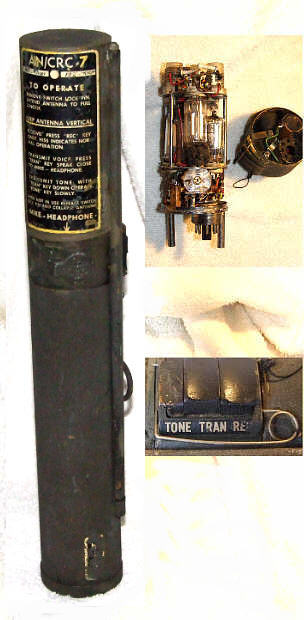
For example, the AN/CRC-7, was the first hand -held VHF AM downed airman's radio.  It was somewhat like a Handie-Talkie in that it could be held in one hand.  But, it had a combination speaker/microphone that changed function when the receive or transmit button was pushed.  It was not like a telephone in appearance or operation (see: http://www.qsl.net/g4bxd/crc7.jpg). 
The BC-222/322 (SCR-194/195) along with the TBY were other early “walkie-talkies” designed by the Army and Navy laboratories.  They were pack radios, and as such designed to be operable while in motion on the operator's back or chest.  Although for these particular radios operation while in motion would result in erratic operation.  Operation at a stationary location was the norm.


The U.S. Navy MAB was a typical chest mounted “walkie-talkie” used during WWII.  It was actually designed prior to the Handie-Talkie for use by Marine paratroops. The Navy MAB was typical of most WWII “walkie--talkies” in that it had a microphone, headset, and antenna, separate from the radio.

The Navy MAB “walkie-talkie” shown with most of its accessories.


One Handie-Talkie feature that was not like a telephone was the need to press a button to switch from receiving to sending.  Most two-way radios to that point in time required such button pushing.  Of course, a cell phone does not.  There were ways to allow simultaneous sending and receiving during WWII, but they were complicated and not amenable to portable equipment.  It wasn’t until the 1970’s that practical simultaneous sending and receiving made the “Handie- Talkie” concept into a true wireless telephone.  The first wireless telephone conversation took place in 1973, but it wasn’t until 1983 that hand held wireless or in this case cellular telephones were available to the public.